
How Much Does a Baby Cost in the First Year in Canada? A Realistic 2026 Budget
On this page
A baby can cost a few thousand dollars in the first year or well over ten thousand before childcare. Both numbers can be honest.
The difference comes from feeding, new versus used gear, convenience spending, gifts, local prices, health needs, and how quickly parents buy solutions at 2 a.m. The biggest financial hit may not be baby products at all. It may be lost income during parental leave or childcare when a parent returns to work.
This guide builds a realistic 2026 budget for direct baby expenses. It keeps parental leave, childcare, housing changes, and uninsured health costs visible but separate. That makes the number useful instead of dramatic.
All government amounts and safety guidance are current as of September 15, 2026. The cost ranges are planning estimates, not official Canadian averages. Replace them with prices available where you live.
The short answer
For one baby in Canada, a practical first year planning range is:
| Cost group | Lean plan | Flexible plan |
|---|---|---|
| One time purchases | $1,300 to $2,000 | $4,000 to $5,500 |
| Recurring baby expenses for 12 months | $2,400 to $3,600 | $6,000 to $7,800 |
| Direct first year baby costs | $3,700 to $5,600 | $10,000 to $13,300 |
These totals cover common gear, diapers, feeding supplies, basic clothing, health and care supplies, and a buffer. They do not include:
- Income lost during maternity or parental leave
- Childcare
- A larger home or vehicle
- Birth costs outside provincial or territorial health coverage
- Major dental, therapy, prescription, or medical expenses
- RESP contributions
A household using hand me downs, breastfeeding without major paid support, cloth diapers, and restrained shopping can spend less. A household using specialty formula, buying premium gear, paying for regular support, or replacing unsuitable products can spend more.
The useful number is not the national average. It is the amount that keeps your household out of expensive debt.
Start with four separate numbers
Do not put every baby related dollar into one total.
1. One time setup costs
This is the gear needed before birth or during the first year. Many items can be borrowed or purchased used after a safety check. A car seat and safe sleep space need more care.
2. Recurring baby costs
Diapers, wipes, formula or feeding supplies, clothing, medicine, solid food, and small replacements arrive throughout the year. These costs change as the baby grows.
3. Parental leave income gap
The leave gap is usually larger than the gear bill. Calculate it separately:
Normal monthly take home income minus estimated leave income after tax equals the monthly leave gap.
Employer top ups may end before government benefits. EI and Quebec benefits are taxable. Review the exact schedule in our 2026 maternity and parental leave benefits guide.
4. Childcare and return to work costs
Childcare may begin late in the first year, after the first birthday, or not at all. Keeping it separate prevents a misleading comparison between families with different leave plans.
Statistics Canada reported that the 2025 national mean expense for full time centre based care was $435 per month for children aged zero to five. That figure covers a broad age group and does not tell you the price or availability of infant care in your community. Get written quotes from actual providers and ask whether they participate in the local fee reduction program.
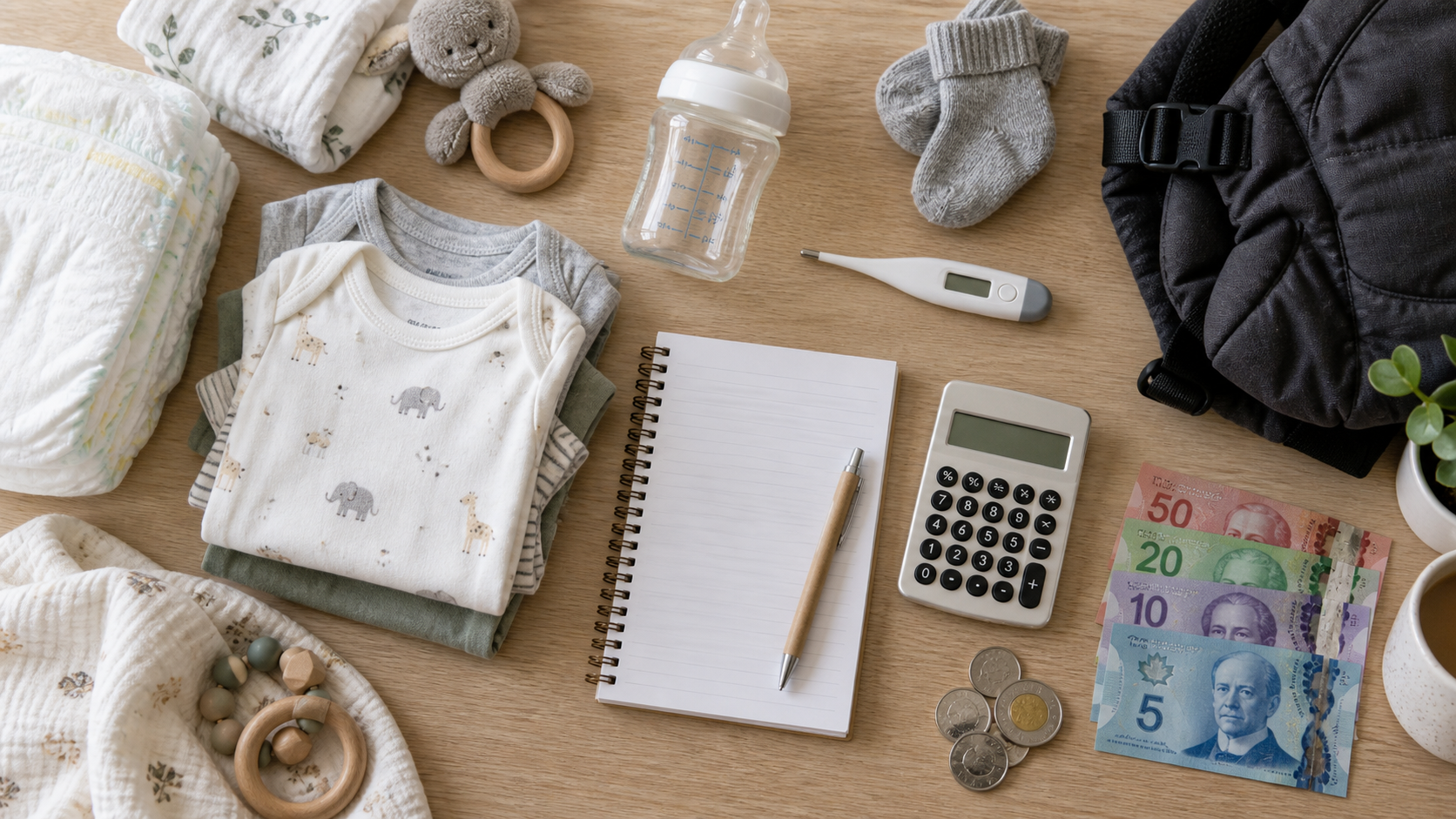
A realistic one time baby budget
Use these ranges as a worksheet. They are not a shopping list.
| Category | Lean planning range | Flexible planning range |
|---|---|---|
| Safe sleep space and fitted sheets | $250 to $500 | $700 to $1,200 |
| Infant car seat | $200 to $350 | $400 to $650 |
| Stroller and carrier | $150 to $400 | $800 to $1,500 |
| Initial feeding supplies | $75 to $200 | $300 to $700 |
| Initial diapers and changing supplies | $75 to $150 | $200 to $500 |
| Clothing for the first sizes | $100 to $200 | $300 to $600 |
| Bath, health, and grooming basics | $75 to $150 | $200 to $400 |
| Baby proofing and later first year gear | $100 to $250 | $300 to $700 |
| Setup buffer | $275 to $400 | $800 to $1,250 |
You will not necessarily spend the high end of every row. A family might buy a premium stroller and use free clothing. Another might use a basic stroller and pay more for feeding equipment.
The setup buffer matters. It absorbs the item you did not know you needed, a different bottle after the first one fails, another sleep sack, replacement pump parts, or delivery fees when leaving the house feels impossible.
What recurring baby costs look like
Recurring expenses are uneven. Newborns use more diapers. Solid food starts later. Clothing arrives in bursts. Formula use can change suddenly.
| Category | Common monthly planning range | First year planning range |
|---|---|---|
| Diapers and wipes | $70 to $140 | $840 to $1,680 |
| Feeding and formula | $20 to $350 | $240 to $4,200 |
| Clothing replacements | $20 to $75 | $240 to $900 |
| Health, pharmacy, and care supplies | $15 to $75 | $180 to $900 |
| Solid food after about six months | $30 to $120 | $180 to $720 |
| Toys, books, and small replacements | $20 to $100 | $240 to $1,200 |
Do not add the maximum from every row and call it typical. Feeding at the high end and solids at the high end may overlap differently. Gifts, swaps, library programs, workplace benefits, and community supports can reduce several categories.
Health Canada recommends breastfeeding exclusively for the first six months and continuing for up to two years or longer with appropriate complementary feeding. It also recognizes commercial infant formula as an alternative when a baby is not breastfed or is partially breastfed. Budget for the feeding plan that is medically appropriate and workable for your family. Do not use a low feeding estimate as pressure to make a health decision.
Two complete first year scenarios
These examples show how the categories can fit together. They are planning models, not promises.
Lean essentials scenario
| Item | Amount |
|---|---|
| One time setup | $1,410 |
| Average recurring spending, $230 for 12 months | $2,760 |
| Direct first year total | $4,170 |
This household uses a basic new car seat, a current compliant used crib or a modest new crib, borrowed clothing, a used stroller from a known source, limited decorative purchases, and mostly free toys and books. Feeding costs stay toward the lower end. The family still keeps a repair and replacement buffer.
Flexible convenience scenario
| Item | Amount |
|---|---|
| One time setup | $5,220 |
| Average recurring spending, $650 for 12 months | $7,800 |
| Direct first year total | $13,020 |
This household buys most gear new, chooses a higher priced stroller, uses more formula or specialized feeding supplies, replaces clothing more often, and pays for convenience. It also keeps a larger buffer for pharmacy trips, delivery, and gear that does not work as expected.
Neither scenario includes leave income loss or childcare.
Build the budget month by month
A single monthly average hides when the money leaves your account. Use twelve columns in a spreadsheet or twelve rows in a notes app.
| Month | Likely cost changes | Budget action |
|---|---|---|
| 1 | Postpartum supplies, frequent diapers, feeding adjustments, pharmacy trips | Keep a large cash buffer and delay optional gear |
| 2 | More diapers, replacement feeding parts, clothing size changes | Compare actual spending with the newborn estimate |
| 3 | Possible bassinet transition planning, larger clothing, more outings | Price the next sleep setup before it becomes urgent |
| 4 | Mobility gear and another clothing size may arrive | Sell or pass on outgrown items promptly |
| 5 | Feeding needs may shift and activity gear becomes tempting | Use a 48 hour wait for nonessential purchases |
| 6 | Complementary foods often begin around this stage | Add a grocery line and basic feeding supplies |
| 7 | More food variety, baby proofing, and floor play | Buy safety items for the hazards in your home |
| 8 | Seasonal clothing and footwear can cause a spending burst | Buy only the size needed for the current season |
| 9 | Childcare deposits or return to work planning may begin | Add provider quotes and commute costs to the forecast |
| 10 | Greater mobility can require gates and cabinet controls | Check recalls and fit before buying used safety gear |
| 11 | First birthday spending and childcare setup may overlap | Set a birthday limit before invitations or shopping |
| 12 | Childcare, commuting, and work clothing may start | Replace estimates with the new working household budget |
For each month, use this formula:
Opening baby fund plus income and benefits minus planned baby costs minus leave gap minus childcare equals closing baby fund.
Then add one stress test:
What happens if the month costs $300 more and one expected payment arrives late?
If the answer is credit card debt, increase the opening buffer, reduce optional purchases, or change the leave and childcare plan before the problem arrives.
A simple way to fund the year
Suppose your direct baby budget is $6,000 and the due date is eight months away.
You could target:
- $2,000 for setup costs before birth
- $3,000 for recurring costs during the first year
- $1,000 as a baby specific surprise buffer
Saving $750 per month for eight months would reach $6,000. That baby fund remains separate from the household emergency fund and the parental leave income gap.
If that monthly target is not realistic, change the spending plan before reaching for debt. Borrow gear, choose a basic stroller, reduce the registry, spread purchases across developmental stages, and direct cash gifts to the baby fund.
Keep a separate emergency fund for job loss, major repairs, and health surprises. Our Canadian emergency fund guide explains how to set the target.
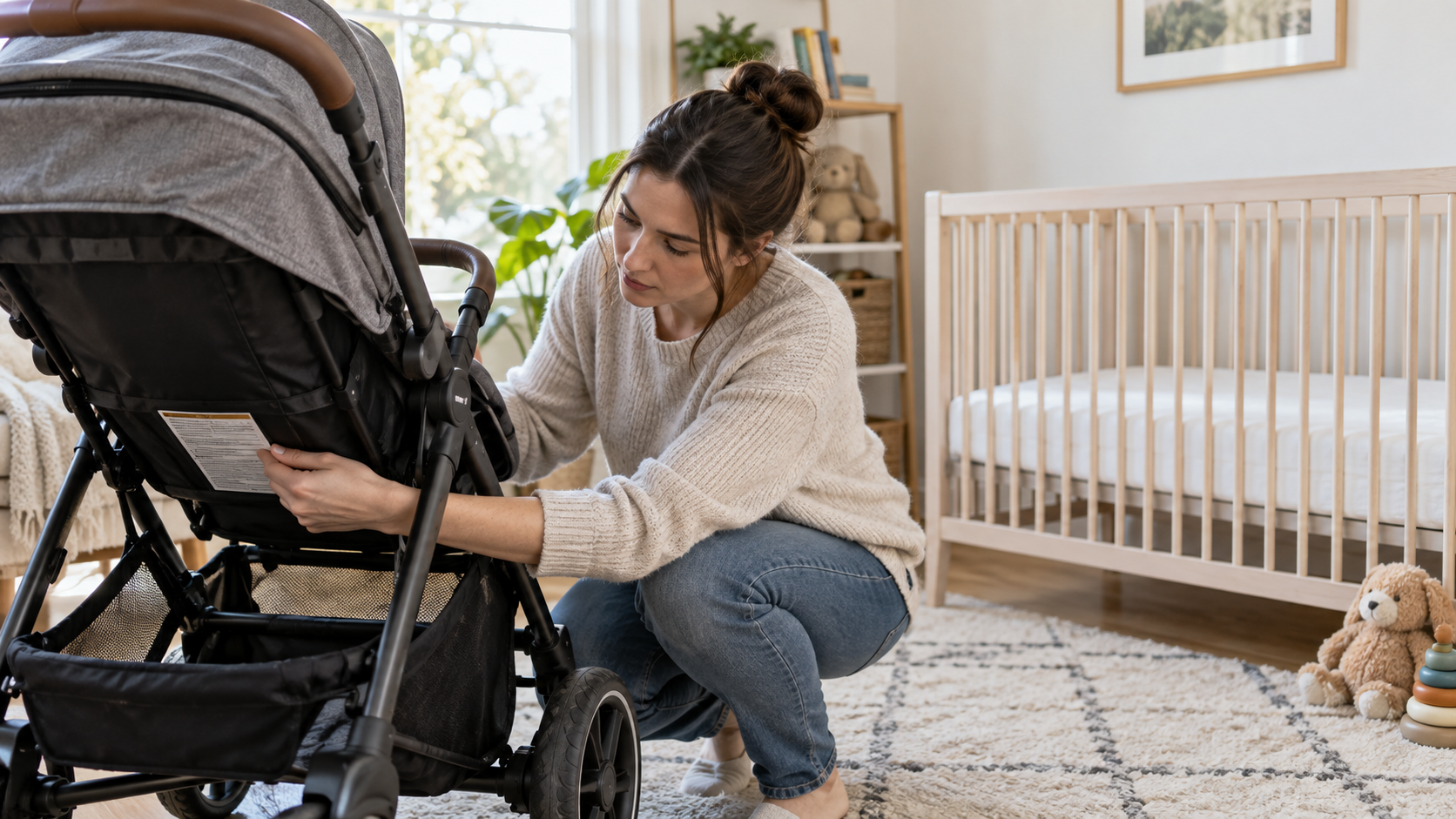
What is safe to buy used?
Used gear can cut the budget sharply. Safety and product history decide whether the savings are worth it.
Car seats require a complete history
Health Canada says not to use a second hand car seat when the seller or lender does not know its history.
Before using one, confirm all of the following:
- It has the National Safety Mark and Canadian compliance labels.
- It is within the manufacturer stated useful life.
- It has never been in a collision.
- It has no cracks, stress marks, damaged webbing, or missing parts.
- The model has not been recalled, or the required recall remedy is complete.
- The manual and installation instructions are available.
- The restraint fits the child and the vehicle.
A new basic car seat is often a better budget choice than a used premium seat with an uncertain history.
Cribs need a current safety check
Health Canada says cribs made before September 1986 are unsafe and drop side cribs are not allowed in Canada. Cribs older than ten years are more likely to have worn or missing parts and may not meet current rules.
For any used crib:
- Confirm the model and check the recall database.
- Reject loose, modified, broken, or missing parts.
- Use only original manufacturer parts.
- Confirm the mattress is firm, flat, and tight fitting.
- Follow the current manual and all age, height, and weight limits.
Health Canada recommends a crib, cradle, or bassinet that meets current Canadian regulations, placed in the parents' room for the first six months. The sleep surface should be firm, flat, and bare with a tightly fitted sheet. Keep out pillows, bumper pads, positioners, toys, mattress toppers, and loose bedding.
Strollers, high chairs, clothing, and toys
These products can often be purchased used when the model is identifiable, the recall check is clear, every required part is present, the product works properly, and it can be cleaned. Skip an item with damage, missing labels, improvised repairs, or no instructions.
Check the federal recalls and safety alerts database before paying. A low price does not repair a missing restraint or reverse a recall.
How to lower first year costs without cutting safety
Buy by stage
A newborn does not need feeding chairs, activity centres, toddler toys, and twelve month clothing on day one. Buy when a need is real. This prevents unused products and keeps cash available.
Put boring essentials on the registry
Ask for diapers in several sizes, wipes, plain sleepers, fitted sheets, pharmacy gift cards, meal support, and contributions to one larger item. A registry does not need to be a showroom.
Borrow short lived gear
Clothing, newborn carriers, infant bath inserts, and age limited toys may be useful for only a few weeks. Borrow from someone you trust, then return or pass them on.
Compare unit prices
The largest diaper box is not automatically the cheapest after coupons, subscriptions, or a size change. Compare cost per diaper and avoid storing more than the baby can use before outgrowing the size.
Keep feeding purchases reversible
Do not buy a year of formula, dozens of one bottle type, or a large inventory of pump parts before you know what works. Start with a small supply and follow medical guidance.
Use public resources
Libraries, public health units, family resource centres, clothing swaps, and community groups can provide books, programs, information, and practical support at little or no cost.
Sell while items still have value
Clean, photograph, and list outgrown gear once you are sure it is no longer needed. Keep manuals and small parts together. Never sell a recalled, expired, damaged, or noncompliant product.
Protect cash, not appearances
The useful stroller is the one that fits your daily life and your vehicle. The useful nursery is the one with a safe sleep space. Nobody receives a return on matching storage baskets.
Why costs vary across Canada
Location changes the budget in several ways:
- Childcare: Fees, infant spaces, subsidies, and participation in public fee programs vary by province, territory, provider, and community.
- Sales tax: The tax added to a product differs by province.
- Shipping and selection: Rural, northern, and remote families may pay more for delivery or have fewer used options.
- Health coverage: Public coverage, drug programs, lactation support, physiotherapy, and private workplace benefits vary.
- Housing and transport: A baby may expose space or vehicle constraints that have little to do with baby gear.
- Family support: Nearby relatives can change childcare, meal, clothing, and transportation costs.
- Leave benefits: Quebec uses the Quebec Parental Insurance Plan. Other provinces and territories generally rely on federal EI benefits alongside local employment standards.
Build the direct baby budget first. Then add the location specific costs your household will actually pay.
How the Canada Child Benefit fits
The Canada Child Benefit can offset first year costs, but it should not be entered as the maximum until you estimate your own payment.
For July 2026 through June 2027, the maximum for a child under six is $8,157 per year, or $679.75 per month. A family receives that maximum when its 2025 adjusted family net income is below $38,237. The payment declines as income rises, is not taxable, and is recalculated every July using the previous year's tax information.
The timing matters. A family whose income drops during parental leave in 2026 may not see the full effect in its CCB calculation until July 2027 because of the prior year income system.
Parents can generally apply for child benefits during provincial or territorial birth registration through the Automated Benefits Application. The CRA says it should send a notice or payment within eight weeks after receiving the information. Both spouses or common law partners need to file tax returns each year for benefits to continue.
Use the CRA calculator for your estimate. Treat the CCB as household cash flow, not as permission to spend the entire amount on baby products. This article keeps the discussion brief because benefit calculations deserve their own guide.
What about an RESP in the first year?
An RESP contribution is savings, not a baby cost. Keep it outside the spending total.
Once the baby has a Social Insurance Number, families can open an RESP. The basic Canada Education Savings Grant adds 20% to eligible contributions, up to $500 of basic grant each year and $7,200 over the child's lifetime. Lower income families may qualify for the Canada Learning Bond without contributing their own money.
Do not fund an RESP while carrying high interest debt or leaving the household without emergency cash. Open the account for available benefits, then contribute at a sustainable pace. Our RESP guide for Canadian parents covers grants, contributions, plan types, fees, investing, and withdrawals.
Frequently asked questions
How much should I save before having a baby in Canada?
Start with three separate targets: one time baby setup costs, the parental leave income gap, and an emergency fund. A lean direct baby budget might require about $4,000 to $5,000 for the first year. The leave gap can be much larger, so calculate it from expected after tax income rather than using a generic target.
Does the first year really cost $10,000?
It can, but it does not have to. A flexible direct spending plan can reach $10,000 to $13,300 before childcare. A lean plan using safe used gear and fewer convenience purchases can stay closer to $3,700 to $5,600. Feeding needs, gifts, location, and health expenses can move either range.
Is childcare included in the first year estimate?
No. Childcare is shown separately because many families do not begin it during the first twelve months and local infant fees vary widely. Get actual provider quotes and add deposits, closures, meals, late fees, and backup care.
How much do diapers cost in the first year?
A practical planning range is about $840 to $1,680 for disposable diapers and wipes. Actual spending depends on brand, fit, changes per day, bulk pricing, skin needs, and whether the family uses cloth diapers.
How much does formula cost in Canada for the first year?
There is no useful national number for every baby. Product type, package size, age, intake, combination feeding, availability, and medical needs matter. Use current local prices for the product your health professional recommends. A broad budget might allocate up to several hundred dollars per month during formula heavy periods, then adjust from actual use.
Can I buy everything used?
No. A used item is only a bargain when its identity, condition, parts, instructions, and recall status can be verified. A second hand car seat needs a known collision history and remaining useful life. A crib must meet current Canadian rules and have no damage or modifications. Consumables, damaged feeding parts, and anything with an unknown safety history should be replaced.
Should I count gifts in the budget?
Count gifts only after they are received. Registries and hand me downs may reduce spending, but relying on an unconfirmed gift can leave a cash gap close to the due date.
Does the CCB cover the cost of a baby?
For some lower income families, the maximum CCB can cover a large share of direct recurring baby expenses. Many families receive less than the maximum, and the payment does not erase leave income loss, childcare, or housing costs. Estimate the benefit using the CRA calculator.
What is the biggest financial cost of a baby?
For many households, it is the income gap during leave or childcare after leave, not gear. Model those costs separately and read our broader guide on preparing financially for a baby in Canada.
The bottom line
A realistic first year baby budget in Canada starts around $3,700 to $5,600 for a lean direct spending plan and can reach $10,000 to $13,300 for a more flexible one. Childcare, leave income loss, housing, and major health costs sit outside those totals.
Spend on safe sleep and safe travel. Borrow short lived items. Buy by stage. Keep feeding choices medically appropriate. Hold cash for the month that does not follow the spreadsheet.
The goal is not to predict every diaper. It is to make sure one difficult month does not become expensive debt.
Sources
- Canada Revenue Agency: Canada Child Benefit amounts and calculation
- Canada Revenue Agency: Automated Benefits Application
- Health Canada: Creating a safe sleep environment for your baby
- Health Canada: Second hand car seat and booster seat safety
- Transport Canada: Expiry dates on child car seats and booster seats
- Health Canada: Industry guide to second hand products
- Government of Canada: Recalls and safety alerts
- Health Canada: Infant nutrition
- Statistics Canada: Child care arrangements, 2025
- Government of Canada: Education savings benefits and RESP grants
This article provides general information, not personalized financial, tax, legal, medical, or product safety advice. Costs, benefits, taxes, health coverage, and product rules can change. Verify current information with the appropriate government, health professional, product manufacturer, childcare provider, and qualified adviser before making a decision.
Keep reading
Useful next steps
Carney's Productivity Mega Deduction: What Canada's New Business Tax Break Actually Does
Canada's new Productivity Mega Deduction would let businesses immediately expense most eligible capital investments. Here is what the proposal covers, who benefits, and what the 6.4 percent headline really means.
Read nextLearningChildcare Costs in Canada: How Parents Can Budget and Plan for 2026
Plan for childcare costs in Canada in 2026 with current fee data, CWELCC limits, local quote questions, waitlist tactics, backup care, and the child care expense deduction.
Read nextLearningThe RESP Guide for New Parents in Canada: Grants, Contributions, and Withdrawals
A practical 2026 guide to opening and using an RESP in Canada, including CESG and CLB amounts, contribution rules, plan choices, investing, fees, withdrawals, taxes, and what happens if your child does not attend school.
Read nextNewsletter
Get new posts in your inbox.
Finance and tech insights for Canadians — no spam, unsubscribe any time.